Technical Articles

5 Signs Your Gas Analyser Is Letting You Down

Gas analysers are expected to run continuously, often in demanding industrial environments, providing accurate and reliable data day after day. Most of the time, they do exactly that. But like any precision instrument, their performance can degrade – and the signs that something is wrong are not always obvious. The

Read More

Complete Guide to Gas Sampling System Design

Accurate gas analysis depends on far more than the analyser itself. Before any measurement takes place, a representative sample of the process gas must be extracted, conditioned, and delivered to the instrument in a controlled, reliable way. This is the sampling system — and it is one of the most

Read More

Continuous VOC Monitoring for Thermal Oxidisers: Real-World Benefits

In solvent-based manufacturing, emissions control is not simply a compliance exercise. It directly affects process stability, operating efficiency, environmental performance and production confidence. For facilities using Regenerative Thermal Oxidisers (RTOs) to abate Volatile Organic Compounds (VOCs), continuous monitoring provides the real-time data needed to confirm that emissions are being correctly treated –

Read More

Why Certification Matters in VOC Monitoring – MCERTS, EN14181 & EN15267 Explained

When monitoring volatile organic compounds (VOCs) and total hydrocarbons (THC) in regulated industries, accuracy isn’t optional — it’s a legal and operational necessity. Whether you’re managing a waste incinerator, a thermal oxidiser, or a medium combustion plant, your gas analysis system must meet strict performance and certification standards.  At Signal Group, we’ve engineered the SOLAR CEMNEX to not only deliver

Read More

What Makes an Analyser “Reference Standard”?

Setting the Standard in Gas Analysis: Why Reference Methods Matter  In the rigorous domains of emissions monitoring, industrial process control, and advanced atmospheric research, the precision and reliability of gas analysis instrumentation are not merely advantageous; they are foundational to regulatory compliance, environmental stewardship, and scientific advancement. The designation of

Read More

Why CEMS Matter — And How to Get It Right

Understanding the Role of Continuous Emissions Monitoring Systems (CEMS) In an increasingly regulated world, the ability to accurately monitor emissions in real time is no longer a luxury—it’s a necessity. Continuous Emissions Monitoring Systems (CEMS) provide the vital data industries need to: From power generation to cement production, from waste

Read More

Monitoring VOC emissions to ensure US compliance

Global regulations limit the environmental emissions of volatile organic compounds (VOCs) from industrial processes. This is because VOCs contribute to the formation of ozone, a constituent of photochemical smog. Methane and some halogenated VOCs, such as refrigerants, are also powerful greenhouse gases, and thereby contribute to climate change. Also, in

Read More
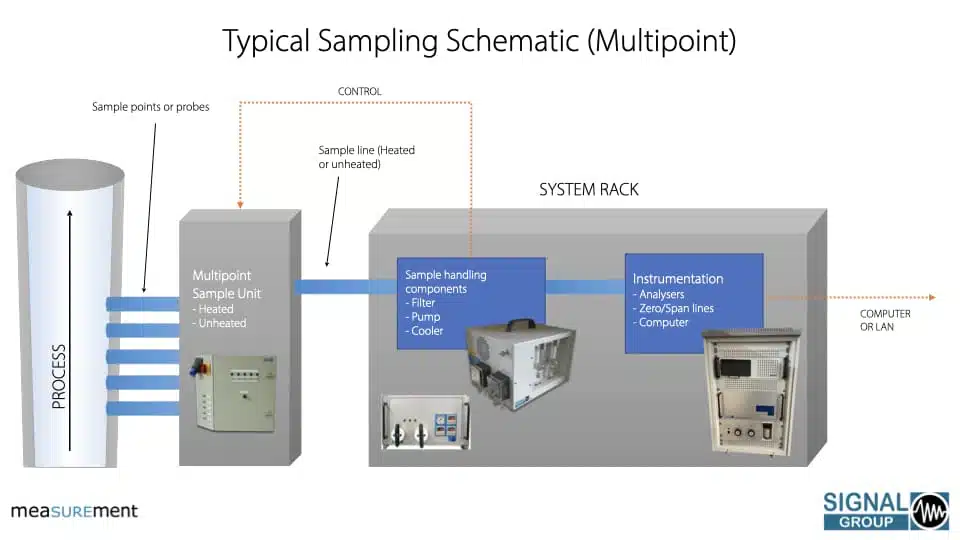
Illustrated diagram of a typical sampling schematic

Gas analysers – extractive or in-situ?

There are two main options for gas analysis in industrial processes or emissions; the analyser can be located inside the gas stream (in-situ), or a sample can be removed from the gas stream (extractive) and transferred to an external gas analyser. As a gas analyser developer and manufacturer with a

Read More